

Visiting expensive US cities on a student budget is genuinely possible — but only if you stop traveling like a tourist. These budget travel tips for expensive cities in the USA break it all down by city — no fluff, just what actually works. New York, San Francisco, and Los Angeles feel unaffordable until you learn where locals actually eat, sleep, and get around. This guide breaks it all down by city — real daily cost estimates, honest warnings, and no brochure-style fluff.
Why These Cities Feel So Expensive (And Why That’s Partially a Myth)
The sticker shock hits the moment you Google hotels near Times Square or restaurants on Fisherman’s Wharf. You’re not seeing the city at that point — you’re seeing the tourist version of it, and the tourist version is always overpriced.
The real cost problem in major US cities comes down to three things: staying in the wrong neighborhood, eating at places with laminated photo menus outside, and paying for transport you didn’t actually need. Cut those three habits and your daily spend drops fast.
Most of the “expensive city” reputation comes from people who booked a Midtown Manhattan hotel at $300/night and ordered a $25 burger. That’s a choice, not a city problem. The version of these cities that locals actually use runs a lot cheaper — you just have to know where to look.
Budget Travel Tips for Expensive US Cities — Rules That Work Everywhere
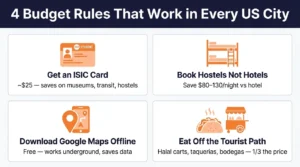
Before getting into city-specific breakdowns, these four habits save money everywhere. Here’s the thing: most students skip at least one of them and regret it halfway through the trip.
Get an ISIC Card Before You Go
The ISIC card (International Student Identity Card) costs around $25 and pays for itself within the first two days. Museums, transit counters, hostels, and tours across every major US city offer student discounts — but some only accept ISIC, not a regular college ID. Grab one before you leave through ISIC.org.
Your university ID still works at most places. Always ask before paying full price — the worst answer you’ll get is no, and that costs you nothing.
Skip the Hotel, Try Hostels
A private hotel room near downtown Chicago can run $180/night. A hostel bed in the same city? $30–50/night, and you’re out exploring all day anyway. For solo travel especially, hostels make sense — you end up meeting people in the same financial situation, which leads to splitting Ubers, sharing food costs, and picking up local tips no travel blog would tell you.
If dorms aren’t your thing, look at neighborhoods 2–3 stops outside the tourist core. Prices drop fast once you’re off the main drag. And if you’re traveling alone for the first time, check out these solo travel tips before you book anything — there’s a hostel safety section in there worth reading.
Download Google Maps Offline
Download the offline map before you land — this one step has saved me more than once. It works in the subway where signal drops, cuts your data usage, and keeps you from standing on a sidewalk staring at a loading circle.
More importantly, use it to find grocery stores, local diners, and parks before you’re hungry and desperate. Desperation is what pushes people into overpriced tourist restaurants.
Eat Where There’s No English Menu Plastered Outside
Real talk: if a restaurant has laminated photos in the window and a host waving you in from the sidewalk, walk past it.
Local taquerias, halal carts, Indian lunch spots, Vietnamese pho joints — these places feed the city’s actual residents and charge accordingly. You eat better, spend less, and feel less like you’re on a guided tour of your own trip.
New York City on a Budget — Is It Actually Doable?
Yes — but it takes planning. Expect to spend $65–90/day if you’re being disciplined. That covers a hostel bed, food, subway rides, and a handful of free activities.
Cheapest Places to Stay in NYC
Skip Manhattan entirely if cost matters. Queens is where the value is. Astoria and Jackson Heights sit 20–30 minutes from Midtown by subway and have hostel options in the $40–60/night range. Long Island City is even closer — practically across the river from Manhattan.
Brooklyn works but has gotten expensive. Bushwick and Ridgewood are the last genuinely affordable pockets if you want to stay on that side.
One honest warning: don’t book any hostel rated under 7.0 on Hostelworld, especially in NYC. A bad hostel here means noisy common areas, cramped bunks, and lockers that feel unreliable. Read the recent reviews, not just the overall score. For a proper breakdown of what to watch for, the travel safety guide covers hostel red flags worth knowing before your first trip.
Eating in NYC Under $15/Day
This is where NYC genuinely surprises people. The street food game here is serious, and it runs cheap.
- Halal carts — Chicken over rice for $7–8, filling, found all over Midtown and beyond
- Dollar pizza slices — Still alive and good. Joe’s Pizza in the West Village is the benchmark
- Bodegas — Egg and cheese on a roll for $3–4. A NYC institution, not a tourist thing
The Trader Joe’s near Union Square is worth a grocery run if you’re staying more than two nights. Pack breakfast and lunch, eat one real meal out, and your food budget stays under $25/day even in New York.
Free Things to Do in NYC
- The High Line — Elevated park, good views, zero cost
- Brooklyn Bridge walk — Iconic, free, takes about 30 minutes end-to-end
- Staten Island Ferry — Free ride, full Manhattan skyline from the water. Tourists pay for boat tours that give them a worse angle
- Central Park — Half a day can disappear here without spending anything
- MoMA — Free on Friday evenings after 5:30pm with a student ID
The subway costs $2.90 per ride in 2026. A 7-day unlimited MetroCard runs about $34 — it pays off by day three if you’re moving around the city properly.
Verdict: NYC is doable. The subway infrastructure alone means you can cover serious ground without burning money on transport. It’s not the cheapest city here, but it’s far from impossible.
If spring break is when you’re planning this, the best spring break destinations guide has an NYC breakdown alongside other options worth comparing before you commit.
San Francisco — The Hardest City to Do Cheap (But Not Impossible)
Let’s be honest: San Francisco is the most expensive city on this list. Don’t come in expecting NYC-style bargains. Budget $75–100/day on a tight plan — and that requires real discipline, not just “being careful with spending.”
Stay Outside SF to Cut Costs
The smartest move is staying in Oakland or Berkeley and taking BART into the city. BART (Bay Area Rapid Transit) runs frequently — depending on where you board, you’re in SF in 15–25 minutes.
A hostel in Oakland runs $35–50/night versus $80–100+ in San Francisco proper. Across a 4-night trip, that gap puts $200 back in your pocket. Spend that on experiences, not the privilege of sleeping closer to a tourist district.
Berkeley is solid too, especially during the semester. Food is cheaper, the energy is good, and BART is right there.
SF’s Surprisingly Free Stuff
SF has free things, but you have to look for them more actively than in other cities.
Walking the Golden Gate Bridge from the Marin Headlands side costs nothing. Most tourists drive; walking the full span and back takes about 90 minutes with the same views and zero entrance fee.
Dolores Park in the Mission District is a genuine social hub. Grab food from the taquerias on 24th Street — some of the best and most affordable Mexican food in the city — and spend a few hours there. No cost, great atmosphere.
SFMOMA is free the first Thursday of each month. Check the schedule before your trip and plan around it if you can.
One honest warning: BART fares add up fast, and Uber/Lyft surge badly inside SF. Plan activities by neighborhood so you’re not crossing the city multiple times in a day.
Los Angeles — Big City, Bigger Savings if You Know Where to Look
LA is a different kind of expensive problem. The city spans hundreds of square miles, and the public transit system still doesn’t reach everything. Budget $65–90/day, but treat transport as the wildcard — it’s the most variable cost in this city.
Getting Around LA Without a Car
LA’s Metro Rail has genuinely improved in recent years, but it still has gaps. What it does cover well: Downtown LA, Hollywood, and Santa Monica — which is enough to reach most of what student travelers actually want to see.
Download the Metro app before you arrive and plan routes in advance. Traveling with 2–3 people? Splitting a Turo rental car for a day or two can beat patching together Ubers. For a full-trip rental though, parking fees and traffic stress usually make it not worth it unless you already know the city well.
Free and Cheap LA Highlights
Here’s where LA actually surprises you — honestly, the free stuff here is some of the best in any US city.
The Getty Center is free admission, always. It’s one of the best art museums in the country, sits on a hill with views across LA, and the tram ride up is also free. Spend a morning here and you’ve spent almost nothing.
Venice Beach is free and worth a morning — bring your own food since the boardwalk vendors charge tourist prices. The beach itself is clean, chaotic in a fun way, and entertaining without spending anything.
Grand Central Market in Downtown LA is the right call for cheap food. It’s a covered market with tacos, Vietnamese food, Korean BBQ, and more. Eat well for $10–14, and the Pershing Square Metro stop is a 5-minute walk away.
One honest warning: Hollywood Blvd and the Walk of Fame are tourist traps. Skip the costumed characters asking for tips, the “celebrity tour” vans, and the overpriced chain restaurants. Head to Los Feliz or Silver Lake — better food, better coffee, no one trying to sell you a star map.
Chicago — The Underrated Budget-Friendly City on This List
Good news if Chicago’s in your plans: it’s significantly more manageable than the coasts. Budget $55–80/day and you’ll eat well, see the city properly, and not feel like you’re running a constant cost calculation in your head.
Honestly, Chicago doesn’t deserve its “expensive city” reputation. It got lumped in with NYC and SF somewhere along the way, and students who skip it based on cost assumptions are missing out. Hotel prices are lower, food is more affordable, and the CTA (Chicago Transit Authority) is reliable in a way that LA’s Metro still isn’t.
Free and Low-Cost Things to Do in Chicago
Millennium Park is free. The Bean (Cloud Gate, officially) is right there, the lakefront is steps away, and in summer the park runs free concerts and outdoor events. A 3-hour morning here costs you nothing except maybe a coffee.
The Art Institute of Chicago runs around $26 for general admission with student discounts available — worth checking your ISIC rate. The collection is serious; this is one of the best art museums in the country and it’s not overpriced at the discounted rate.
The Lakefront Trail runs 18 miles along Lake Michigan, free the whole way. Grab a Divvy bike (Chicago’s bike-share system) for a few dollars and you’ll cover more ground in two hours than most tourists do in a full day on foot.
Eating Cheap in Chicago
Skip the full sit-down deep dish experience at Giordano’s or Lou Malnati’s unless you’re splitting it with a group — a whole pie adds up fast for one person. A thin-crust tavern-style pizza slice from a neighborhood spot runs $3–4 and, honestly, is a better solo meal anyway.
Chicago’s neighborhood food options are genuinely strong. The Pilsen and Logan Square areas have good, affordable food without tourist pricing. The closer you get to Navy Pier or Michigan Avenue, the more you’re paying for the location.
Miami — Sun and Beaches, But Watch Your Wallet
Miami is gorgeous, and the beaches are free. That’s the best thing about visiting on a budget — the main reason people come costs absolutely nothing. Budget $60–85/day if you’re disciplined, but Miami has a specific way of pushing people past that number without them noticing.
Where to Stay in Miami on a Budget
Stay in Little Havana or Wynwood instead of South Beach. I’d pick Wynwood every time — better street art, better coffee, and nobody’s trying to charge you a cover fee for standing outside a bar. Hostels in these areas run $35–55/night.
The issue with South Beach isn’t just accommodation cost — it’s the whole ecosystem. Restaurants on Ocean Drive charge $20+ for a cocktail and add a service charge on top. Clubs are designed to extract money at every step. If that scene isn’t your thing, staying one neighborhood over saves you significantly.
Free Things to Do in Miami
The beach itself? Free. South Beach, Miami Beach — all of it, free. Parking near it is absolutely not free — budget $20–30 for a spot if you’re driving, or take the bus and skip the headache entirely.
Wynwood Walls is free to walk past and photograph, though some parts have started charging small entry fees — check before you go. The surrounding area has good food and street art without tourist pricing.
The Metromover (downtown Miami’s free transit loop) connects Brickell, Downtown, and Overtown at no cost. Not glamorous, but it works for getting around the central area without spending on Ubers.
Eat Cuban food in Little Havana. Ropa vieja or a Cuban sandwich from a local spot runs $10–14 and fills you up. Versailles on Calle Ocho is the famous name, but walk half a block and find something similar for less.
One honest warning: Miami heat from May through September is serious. Budget accommodation often means less reliable AC, and that’s not a minor inconvenience in a Miami August. Time your trip to the right months if you can — November through March is when the weather actually works in your favor.
Quick Comparison — Which City Is Cheapest to Visit in 2026?
The cheapest expensive US city to visit on a student budget is Chicago, followed by Miami and Los Angeles. New York and San Francisco cost more but stay manageable with the right approach.
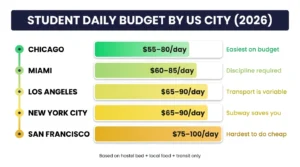
Here’s a quick breakdown to help with your budget travel tips research across these expensive cities in the USA:
| City | Avg Daily Budget | Best For | Hardest Part |
|---|---|---|---|
| Chicago | $55–80 | Budget-conscious first-timers | Flights can cost more to get there |
| Miami | $60–85 | Beach trips, warm weather | Nightlife culture pushes spending up |
| Los Angeles | $65–90 | Free museums, beaches, culture | Getting around without a car |
| New York City | $65–90 | Urban experience, student discounts | Accommodation cost |
| San Francisco | $75–100 | Outdoors, food scene, tech culture | Overall cost of living |
These ranges assume a hostel bed, two budget meals plus one grocery run per day, and local transit only. Flights are a separate budget category. Before you book anything, run the numbers through the student travel budget calculator — it breaks down full trip costs by destination and cuts out the guesswork.
Getting Between Cities Cheap — Flights, Buses, and Trains
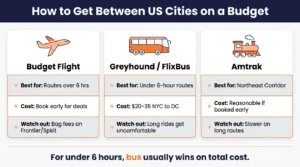
If you’re visiting more than one city, how you travel between them matters as much as what you do there.
Flights are often the fastest option but not always the cheapest once you add up airport time and transport to and from terminals. Southwest doesn’t charge for checked bags, which matters when you’re carrying a full pack. Frontier serves a lot of US city pairs at low base prices — but bag fees eat your savings fast if you’re not traveling light. The Frontier student discount guide breaks down exactly when Frontier is worth it and when it isn’t, which saves you from a bad booking. For timing and booking strategy across all US carriers, the cheap student flights to USA guide is worth a read before you search.
Greyhound and FlixBus cover most major city pairs at prices that undercut flights significantly. New York to DC runs around $20–35. LA to SF is a common Greyhound route. For distances under 6 hours, the bus math usually wins — especially if you pack your own food.
Amtrak sits between the two. The Northeast Corridor — Boston, NYC, DC — is genuinely good. Trains run on schedule, they’re comfortable, and they’re reasonably priced if you book a few weeks out. The California Zephyr from Chicago to San Francisco takes time, but the scenery is worth it, and a sleeper car booked early can come in cheaper than two nights of hotels.
One honest comparison worth making: flying LA to SF takes 1.5 hours, but total airport time makes it a 4-hour commitment. The Amtrak Coast Starlight drops you in downtown SF. For city-center to city-center trips, trains often beat the full airport experience when you count time honestly. And if you’re packing smart for all of this, the travel packing guide will help you stay light enough that bus and budget airline fees stop being a problem.
Frequently Asked Questions
What is the cheapest expensive city to visit in the USA?
Chicago is the most budget-friendly among major US cities typically labeled expensive. A student traveler can get by on $55–80/day — covering a hostel bed, local food, and transit. Free attractions like Millennium Park and the Lakefront Trail are genuinely worth your time, and food prices are noticeably lower than anything on the coasts.
How much does a budget trip to NYC cost per day in 2026?
A realistic daily budget for NYC in 2026 is $65–90 for student travelers. That covers a hostel bed in Queens or Brooklyn ($40–60/night), street food plus one sit-down meal, and subway rides at $2.90 each. A 7-day unlimited MetroCard ($34) cuts transport costs if you’re staying a full week.
Can you actually visit San Francisco on a student budget?
Yes, but it’s the hardest city on this list to do cheaply. The key move is staying in Oakland or Berkeley and taking BART into SF — hostel beds there run $35–50/night versus $80–100+ in the city. Budget $75–100/day total and plan your activities by neighborhood to avoid paying multiple BART fares in one day.
What are the best free things to do in major US cities?
Every city here has solid free options. In NYC: the High Line, Brooklyn Bridge walk, Staten Island Ferry, and MoMA on Friday evenings. In LA: the Getty Center is always free. Chicago’s Millennium Park and Lakefront Trail cost nothing. SF’s Golden Gate Bridge walk and Dolores Park are both free. Miami’s beaches are free all day, every day — that one’s hard to beat.
Are hostels safe for solo college students traveling in the US?
Yes — hostels rated 8.0 or above on Hostelworld are generally safe for solo student travelers. Use a locker for valuables, read recent reviews before booking, and avoid anything under 7.0 especially in NYC. Solo travelers often get more out of hostels than hotels anyway — you meet people, share transport costs, and pick up local tips you’d never Google.
Do student discounts actually work in US cities?
They do, but you have to ask. An ISIC card (around $25 at ISIC.org) unlocks discounts at museums, hostels, and transit counters that don’t accept a regular college ID. Your university ID covers most major museums and some transit passes. Always ask before paying full price — many discounts aren’t advertised at the window.
What’s the cheapest way to get between major US cities?
For distances under 6 hours, Greyhound or FlixBus almost always beats flying on total cost — New York to DC runs $20–35 on a bus. For longer routes, compare Amtrak early-booking fares against flights. The Northeast Corridor (Boston–NYC–DC) is especially competitive on Amtrak. If flying, Southwest is the best pick for budget travelers carrying a bag since checked bags fly free.
Conclusion
Planning a trip to an expensive US city doesn’t mean draining your account for a week. The students who pull these trips off aren’t doing anything special — they’re staying in the right neighborhood, eating where locals eat, and not paying for convenience they don’t actually need.
Chicago is the easiest starting point if you’ve never done this before. NYC rewards the planning you put in. San Francisco is hard but achievable with the Oakland strategy. Every city on this list has a cheaper version of itself — you just have to look one layer past the tourist surface.
If international travel is on your radar too, check out budget student trips to South America — some of those destinations cost less per day than a Chicago hostel weekend, which puts things in perspective.
Got a city-specific tip I missed, or a budget breakdown from your own trip? Drop it in the comments — other students reading this will find it genuinely useful.

Awamar Chheena is the founder of Travel Tips for Students. He writes practical guides to help students find travel deals, student discounts, and budget-friendly tips. His goal is to make travel more affordable for students around the world.