

What to Do When You Hire the Wrong Tour Guide (Student Travel Guide)
Hiring a tour guide is supposed to make your trip easier, safer, and more meaningful. But for many student travelers, the experience can quickly turn frustrating when the guide turns out to be unprofessional, misleading, or simply not worth the money.
If you’re traveling on a tight student budget, choosing the wrong tour guide doesn’t just waste money — it can ruin learning opportunities, create stress, and even put your safety at risk. This guide explains what to do when you hire the wrong tour guide, how to spot red flags early, and how students can recover without ruining the entire trip.
Why Hiring the Right Tour Guide Matters for Students
For more insights on safe and budget-friendly travel, you can also explore reliable student travel platforms like Lonely Planet, Rick Steves Europe, and Hostelworld travel guides, which offer verified information and traveler reviews.
Students often travel with limited funds, fixed schedules, and high expectations to learn something new. A bad tour guide can lead to:
-
Wasted money that can’t be recovered easily
-
Missed cultural and educational experiences
-
Discomfort, confusion, and unnecessary stress
-
Poor safety planning or risky situations
Choosing the right guide builds credibility, ensures accurate local knowledge, and creates a smoother experience — especially for first-time or young travelers.
- If you’re traveling alone, make sure to read our complete guide on
Solo Travel Tips for Students
to stay safe, confident, and budget-friendly during your journey.
How to Detect a Bad Tour Guide Early
Spotting problems early can save you time, money, and frustration.
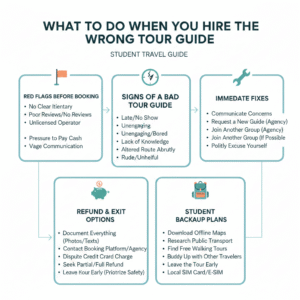
🚩 Pre-Tour Red Flags
Watch out for these warning signs before booking:
-
Over-promising experiences that sound “too good to be true”
-
No certifications, licenses, or clear credentials
-
Vague endorsements or fake-looking reviews
-
Hidden fees or unclear itineraries
-
Pressure to book immediately without details
🚩 On-Tour Red Flags
If you notice these within the first hour, take action:
-
Poor communication or weak language skills
-
Lack of passion, punctuality, or professionalism
-
Ignoring basic safety rules or group management
-
No explanation of history, culture, or local context
-
Pushing shopping stops instead of actual sightseeing
What to Do If You Hire the Wrong Tour Guide
If things feel off, you don’t have to stay silent.
Immediate Fixes
-
Politely ask questions about the route, content, and costs
-
Clarify what was promised versus what is being delivered
-
Call or message the booking platform or agency immediately
-
Request a replacement guide if available
-
Ask for a partial refund if the service is clearly poor
-
Leave the tour and switch to:
-
Free walking tours
-
Peer-led hostel tours
-
Self-guided exploration using public transport
-
Many student travelers recover their day simply by switching plans early.
If Things Go Really Wrong
Sometimes, ending the tour is the best option.
-
Leave the tour respectfully and calmly
-
Document everything (photos, messages, receipts)
-
Save screenshots of the original booking details
-
Leave an honest, detailed review online
-
Share your experience in student travel forums or hostel boards
Your feedback can protect other students from the same mistake.
Real Student Travel Experiences
Amber (Student Traveler)
Booked a cheap “budget group tour” that turned out to be scam-like and rushed. She left early, joined a hostel walking tour, and later shared her experience on a hostel blog to help other students avoid the same mistake.
James (University Student)
Joined a tuk-tuk market tour where the guide kept pressuring the group to shop. James left midway and joined a free university-led city tour instead.
Key Lesson: Flexibility + speaking up + local networks often save the trip.
Before booking any tour, always cross-check with trusted travel resources like
Lonely Planet Travel Guides
to ensure the tours are safe and student-friendly.
Good vs Risky Tour Guides (Student Comparison)
| Feature | Student-Friendly Guide | Risky Tour Guide |
|---|---|---|
| Reviews | Verified student feedback | Few or fake reviews |
| Pricing | Clear fees & itinerary | Hidden charges |
| Communication | Fluent in common languages | Poor language skills |
| Safety | Explains emergency plans | Only gives meeting point |
| Flexibility | Allows route changes | Forces fixed plans |
Booking Checklist for Student Travelers
Before booking, also review trusted resources such as Lonely Planet travel safety guides and Rick Steves’ travel advice to compare standards and expectations.
Before booking any tour guide, ask yourself:
-
Is this guide recommended in student or hostel forums?
-
Are group size, itinerary, and costs clearly mentioned?
-
Is there a refund or exit policy?
-
Does the guide speak a language you’re comfortable with?
-
Are safety measures clearly explained?
If the answer is unclear — don’t book.
You can also verify tour safety and planning tips from
Rick Steves’ Travel Tips
which explain what to look for in local guides.
Expert Insight
“Young people travel to experience cultures, not guided robots.”
— Dr. Lena Alvarez, Cultural Tourism Researcher
FAQs: What to Do When You Hire the Wrong Tour Guide
Q1. What if I’m halfway through a multi-day tour with a bad guide?
Contact the agency immediately, request a guide change, or go partially self-guided. Document all issues.
Q2. Can I get a refund if the guide misrepresents a site?
Yes. Keep proof such as screenshots, itineraries, and payment receipts, and request a partial refund.
Q3. How can I vet a tour guide before booking?
Check student reviews, forums, credentials, and detailed itineraries.
Q4. Are free walking tours safe for students?
Yes, if they are licensed, well-reviewed, and locally verified.
Q5. What if I don’t speak the local language?
Choose guides fluent in English and ask them to teach basic local phrases.
Q6. Does booking in advance help?
Yes, but always reconfirm details before the tour date.
Q7. What’s the best backup plan if everything fails?
University city walks, hostel staff advice, cultural centers, local libraries, or public transport apps.