

If you’re looking for paris travel tips for students that actually apply to Americans — not EU tourists — you’re in the right place. Paris is doable on a college budget. But plenty of students figure that out the hard way. So consider this your no-fluff filter: what actually matters when you’re 20, broke-ish, and trying to see the Eiffel Tower without a financial meltdown afterward.
Real advice. US-student specific. No tourist brochure energy.
I’ve spent the last two years researching student travel deals and budget routes so you don’t have to figure it out the hard way.
Is Paris Actually Affordable for College Students?
Short answer: yes — if you’re realistic about it.
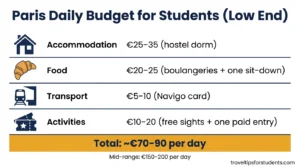
The low-budget range runs around €70–90 per day. That covers a hostel bed, boulangerie meals, public transport, and a solid mix of free and cheap sightseeing. Eat like a local instead of a tourist, and Paris is very doable.
Here’s roughly where your money goes each day at the low end:
- Accommodation: €25–35 (hostel dorm)
- Food: €20–25 (boulangeries, markets, one sit-down meal)
- Transport: €5–10 (metro/bus with a Navigo card)
- Activities: €10–20 (mix of free sights and one paid entry)

Mid-range sits around €150–200 per day — that’s private hotel rooms and restaurant dinners every night. Most students don’t need that. The city rewards people who eat cheap and walk a lot.
One honest warning though: Paris isn’t Southeast Asia cheap. A café coffee runs €3–4. A sit-down lunch is €12–15. Budget for reality, not wishful thinking. (And if you want a broader framework for managing costs before you even book flights, our guide to budget travel in expensive cities covers a lot of the same mindset.)
These paris travel tips for students start with one rule: budget for reality.
Before You Book — 2026 Planning Checklist for US Students
Passport & ETIAS — The New Requirement Americans Can’t Ignore
Here’s the thing most Paris guides quietly skip for American readers — so pay attention.
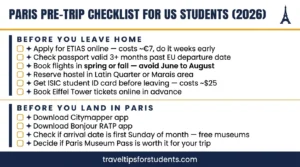
US citizens traveling to France in 2026 need to apply for ETIAS (European Travel Information and Authorization System) before their trip. It’s not a visa. Think of it like ESTA, but for Europe — a pre-travel authorization you apply for online. It costs around €7 and takes maybe five minutes to complete. Approvals usually come through fast, but don’t do it the night before your flight. Apply for ETIAS on the official EU travel portal well in advance.
Your passport also needs to be valid for at least three months beyond your EU departure date. Don’t show up with one expiring two months after your trip — you could get denied boarding.
When to Go (and When to Avoid)
Spring (April–May) and fall (September–October) are the sweet spots. Crowds are manageable, weather’s comfortable, and US flights are noticeably cheaper than peak summer.
June through August is the worst window for budget travelers. Hostel prices spike. Every major sight has brutal lines. The city runs 20–30% more expensive across the board.
If summer is your only option, book flights and accommodation months in advance. Prices don’t negotiate once peak season hits.
Where to Stay in Paris as a Student
Latin Quarter — Best Neighborhood for Students
The Latin Quarter (5th and 6th arrondissements) is the go-to neighborhood for student travelers, and genuinely earns that reputation. It’s central, walkable to major sights, and has a young crowd. You’ll find affordable restaurants, cafés that won’t rush you out, and easy metro access throughout.
The Marais (3rd and 4th arrondissements) is another strong pick — trendy, walkable, and well-positioned for free museum browsing on first Sundays.

Avoid the 1st arrondissement on a budget. It’s the most convenient location in Paris, but hotels there are luxury-priced by default.
Hostels vs. Budget Hotels — What’s Worth It
For most students, hostels are the move. A dorm bed at a solid Paris hostel runs €25–40 per night. Generator Paris is a consistently popular option — modern, social, and centrally located.
Real talk: don’t pick accommodation purely based on price if it puts you far from the center. Staying in the suburbs might save €10 a night — but you’ll spend more on metro fares and lose an hour of your day commuting. Stay inside the Périphérique.
Getting Around Paris Without Wasting Money
The Navigo Easy Card — Your Most Important Purchase
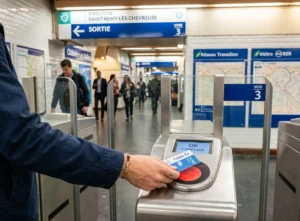
Skip individual metro tickets entirely. The Navigo Easy Card is a reusable contactless card you top up with rides or passes. The card itself costs €2, and you can load it with single trips, carnets (10-ride packs), or unlimited day passes.
Pick one up at any metro station ticket office when you land. Staying a week? A weekly Navigo pass (Monday–Sunday, all zones) is the best value. For shorter stays, a day pass at €8.65 covers you well.
Two apps worth downloading before you even board your flight:
- Citymapper — best for planning routes across metro, bus, and walking
- Bonjour RATP — official Paris transit app, lets you top up your Navigo digitally
RER B — How to Get from CDG Airport Without Getting Ripped Off
Charles de Gaulle Airport connects directly to central Paris via the RER B train. The ride takes 35–40 minutes and costs around €11–12. That’s your option.
Taxis and Ubers from CDG run €50–70+. Unless you’re splitting three ways with friends, the RER wins every time.
Worth noting: the Roissybus (RATP express bus) is slightly cheaper than the RER B and drops you near Opéra. Good backup if you’re staying in that area.
Walking and Vélib’ Bikes
Paris is genuinely one of the most walkable cities in the world. Group your sights by neighborhood and plan days geographically — you can easily cover 4–6 miles without it feeling like a workout.
Vélib’ is Paris’s bike-share system. Blue bikes are manual, green ones are electric-assist. A single 30-minute ride runs €1–3. The city has massively expanded cycling infrastructure since 2020, so it’s a real daily option now — not just a tourist novelty.
Student Discounts in Paris — What Americans Actually Qualify For
This is the section most Paris guides get wrong. Here’s the honest breakdown.
The EU Museum Free Entry Truth (Don’t Get Surprised)
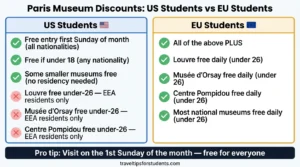
Most articles mention Paris museums are “free for under-26s.” What they don’t tell you — and honestly, this matters more than people think — is that this mostly applies to EEA (European Economic Area) residents, not American tourists by default.
At the Louvre, free under-26 entry requires EU/EEA residency. Americans aren’t automatically eligible. Same story at the Musée d’Orsay, Centre Pompidou, and most other national museums.
But here’s what does actually apply to everyone:
- First Sunday of the month — the Louvre, Musée d’Orsay, and many others offer free admission to all visitors, regardless of nationality. Plan at least one museum day around this.
- Under-18 rule — anyone under 18 gets in free at most national museums, no matter where they’re from. Worth knowing if you’re on a gap year.
- Some smaller museums — the Musée de la Poste and BNF Richelieu offer free entry to all under-26s without a residency requirement. Always check each museum’s official site before you go.
ISIC Card — Is It Worth It for US Students?
The ISIC card (International Student Identity Card) is the globally recognized student ID. It costs around $25 and unlocks discounts across Paris — including 10% off Generator Hostels and discounts with New Europe walking tours.
It’s not a game-changer on its own. But if you’re traveling for more than a week and hitting multiple hostels or tours, it covers its cost quickly. Get it before you leave the US. (For a broader look at which student travel discounts are actually worth it, we’ve covered that separately.)
Paris Museum Pass — When to Buy It
The Paris Museum Pass gives you skip-the-line access to 50+ museums and monuments — the Louvre, Musée d’Orsay, Arc de Triomphe, Versailles, and more.
Worth buying if you’re hitting three or more paid attractions. Prices in 2026 run roughly €55 for 2 days, €69 for 4 days (check current rates — they update seasonally). One detail most people miss: even with the pass, you still need to book a timed entry slot at the Louvre. The pass skips the payment line, not the reservation system.
Eating in Paris Without Eating Your Budget
Here’s where most tourists go wrong: they eat near the sights and pay sight prices. You don’t have to.
Boulangeries are your best friend. A fresh baguette costs around €1.20. Add a jambon-beurre sandwich and you’ve got a full lunch for under €5. There’s one on practically every block — this is genuinely how Parisians eat on the go, and it’s delicious.

Prix fixe lunch menus at non-touristy restaurants typically offer entrée + main + dessert for €14–18. The same meal at dinner costs noticeably more. Eat your one real sit-down meal at lunch.
Tap water is free and completely safe. Don’t order bottled water. Just ask for “une carafe d’eau, s’il vous plaît” — some servers are slow to offer it, but they’ll bring it.
Want a real Parisian food experience on a budget? The Marché des Enfants Rouges in the Marais is worth a visit. It’s the oldest covered market in Paris, and you can eat well for €8–12 at the communal tables. (Honestly, this one surprised me — it’s way less touristy than you’d expect for something that good.)
Avoid restaurants on the main drag near the Eiffel Tower and Notre-Dame. Those spots know you’re passing through and price accordingly.
Top Things to Do in Paris on a Student Budget
Free and Nearly-Free Sights
Paris has way more free things than people realize:
- Seine riverbanks — walk from the Notre-Dame area toward the Eiffel Tower. One of the best views in the city, and it costs nothing.
- Notre-Dame exterior — reconstruction is still ongoing, but the surrounding area is stunning. Free to walk.
- Montmartre and Sacré-Cœur — the basilica is free to enter. The neighborhood is one of the best in Paris for just wandering around.
- Jardins du Palais Royal — a beautiful, mostly tourist-free garden right in the center. Good spot to decompress mid-day.
- First Sunday free museums — plan at least one museum day around the first Sunday of the month.
Experiences Worth Paying For
Some things are worth the spend. The Eiffel Tower summit is the obvious one — book tickets online well in advance. Lines without a pre-booked ticket are brutal and sometimes just impossible.
Sainte-Chapelle gets skipped by a lot of first-timers, which is a mistake. The stained glass is genuinely one of the most beautiful things in the city. Entry runs about €13 and the lines are much shorter than the Louvre.
One Seine river cruise in the evening is worth doing once. They run around €15–17, and the views of Paris after dark are hard to argue with.
Paris Travel Tips for Students: Safety & Scams
Paris is genuinely safe for students. Petty theft, though? Very real — and tourists get targeted because they’re easy to spot.

Pickpocket hotspots: Eiffel Tower, Sacré-Cœur, the RER B from CDG, and crowded metro cars. Keep your bag in front of you. Don’t use your back pocket for your phone. A crossbody bag with a zipper beats a backpack every time in these areas.
Common scams worth knowing:
- The petition scam — someone approaches with a clipboard, asks you to sign for a cause. An accomplice goes for your pockets while you’re distracted. Walk away without making eye contact.
- Friendship bracelet trick — someone starts tying a bracelet on your wrist, then demands payment. Don’t let anyone touch your hands.
- The “found” gold ring — someone picks up a ring near you and insists it’s yours or offers to sell it. It’s worthless. Keep walking.
Does any of this mean Paris is dangerous? Not at all. Know the tricks, stay alert, and you’ll be fine.
Language: Most young Parisians and hospitality workers speak solid English. You don’t need to be fluent. But starting every interaction with “Bonjour” makes a real difference — it signals basic respect and usually gets a warmer response. Three phrases worth knowing: Bonjour (hello), Pardon (excuse me), and L’addition, s’il vous plaît (the check, please).
Solo travel: Paris is one of the better European cities for solo travelers. Use common sense around Gare du Nord late at night, but the rest of the city is genuinely fine.
FAQ SECTION
Is Paris expensive for college students? Paris runs around €70–90 per day on a low student budget. That covers a hostel dorm, boulangerie meals, metro transport, and a mix of free and cheap sightseeing. It’s not budget-backpacker cheap, but it’s very manageable if you eat like a local, walk between neighborhoods, and skip tourist-trap restaurants near major sights.
Do American students get free museum entry in Paris? Not automatically. Most “free under-26” museum policies apply to EEA residents — not US tourists by default. However, all visitors get free entry to the Louvre and Musée d’Orsay on the first Sunday of each month, regardless of nationality. Some smaller museums offer free entry to all under-26s too. Always check the museum’s official site before you go.
Do I need a visa to visit Paris as a US student? No visa required for short stays. But as of 2026, US citizens need ETIAS — a quick online pre-travel authorization that costs around €7. Apply before your trip via the official EU travel portal. Your passport also needs to be valid for at least three months beyond your EU departure date.
What’s the cheapest way to get around Paris? The Navigo Easy Card. It’s a reusable contactless card you load with metro rides or day passes. A weekly unlimited pass covers all zones Monday to Sunday — best value for stays of 5+ days. For shorter trips, day passes at €8.65 work well. Download Citymapper before you land for easy route planning across metro, bus, and walking.
Is Paris safe for solo college students? Yes — Paris is one of the safer major European cities for solo travelers. The main risk is pickpocketing around the Eiffel Tower, Sacré-Cœur, and crowded metro cars. Keep your bag in front of you, avoid back pockets for your phone, and stay alert around Gare du Nord late at night. The rest of the city is generally fine.
When’s the best time to visit Paris as a student? Spring (April–May) and fall (September–October) are the best windows. Crowds are smaller, weather’s pleasant, and US flight prices are noticeably lower than summer. Summer is the worst time for budget travelers — accommodation and attraction prices spike significantly. If June–August is your only option, book everything months in advance.
Is the Paris Museum Pass worth it for students? Yes, if you’re visiting three or more paid attractions. The 2-day pass runs around €55, the 4-day around €69 — check current rates, as prices update seasonally. It includes skip-the-line access to 50+ museums. One thing people miss: you still need to book a free timed entry slot at the Louvre even with the pass.
CONCLUSION
Paris rewards students who show up prepared — not the ones with the biggest budget. Know which discounts actually apply to Americans, grab a Navigo card the moment you land, eat at boulangeries instead of tourist restaurants, and plan at least one museum day around the first Sunday of the month. The best paris travel tips for students come down to three things: plan early, eat local, and know your discounts.
It won’t be a flawless trip. There’ll be a line longer than it looked online and at least one overpriced coffee bought out of sheer exhaustion. That’s fine. Paris is still Paris — and for a first real international trip, it’s hard to beat.
Still in the planning phase? Check out our solo travel tips for first-time student travelers — a lot of the same logic applies. Already been? Drop your best Paris budget tip in the comments. Other students planning their trips will genuinely appreciate it.

Awamar Chheena is the founder of Travel Tips for Students. He writes practical guides to help students find travel deals, student discounts, and budget-friendly tips. His goal is to make travel more affordable for students around the world.